






The B2B tech market is moving fast. Marketing and sales teams need to keep up with emerging technologies, while also understanding what types of messaging decision makers trust.
Each month, we explore the issues shaping real-world technology decisions, drawing on insight from 100 IT leaders in our expert network, the Vanson Bourne Community.
Welcome to the May edition of Signals.
This month, we set out to understand:
- Whether vendor collaboration builds trust among decision makers
- Why AI security announcements risk being seen as promotional
- What decision makers need to see before collaboration becomes a credible buying signal
In our March Signals article, we looked at how IT and technology decision makers are navigating an increasingly complex buying journey, where trust is harder to build and decision makers are looking for more credible ways to validate vendor claims.
This month, we wanted to understand how that trust plays out in one of the fastest-moving areas of the market, namely AI security and responsible AI.
Technology vendors are increasingly working with partners, industry bodies and, in some cases, companies they would usually compete with, to address emerging risks. Anthropic’s Mythos and Project Glasswing collaboration, where multiple cybersecurity providers are involved, is one recent example of this type of initiative.
This kind of collaboration raises an important question for B2B technology brands:
Do decision makers see it as a meaningful trust signal, or just another promotional announcement?
We asked UK IT decision makers involved in technology purchasing for their views on vendor collaboration, AI security, responsible AI and where this information fits into the buying journey. The findings reveal both an opportunity and a warning. Buyers are open to collaboration, and in many cases, it increases trust. Yet they are also alert to “hype” and unsupported claims or announcements that feel more promotional than practical.
In summary, collaboration can build trust but trust only turns into credibility when decision makers see proof.
Collaboration is becoming a trust signal
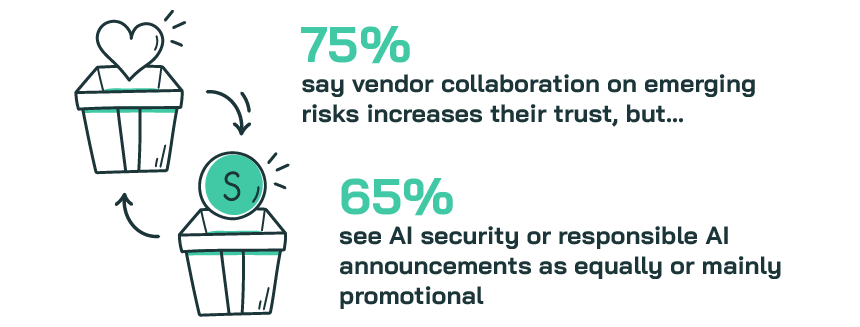
IT decision makers are positive about collaboration, with over seven in ten (75%) saying vendors working with other organisations, including usual competitors, to address emerging risks increases their trust.
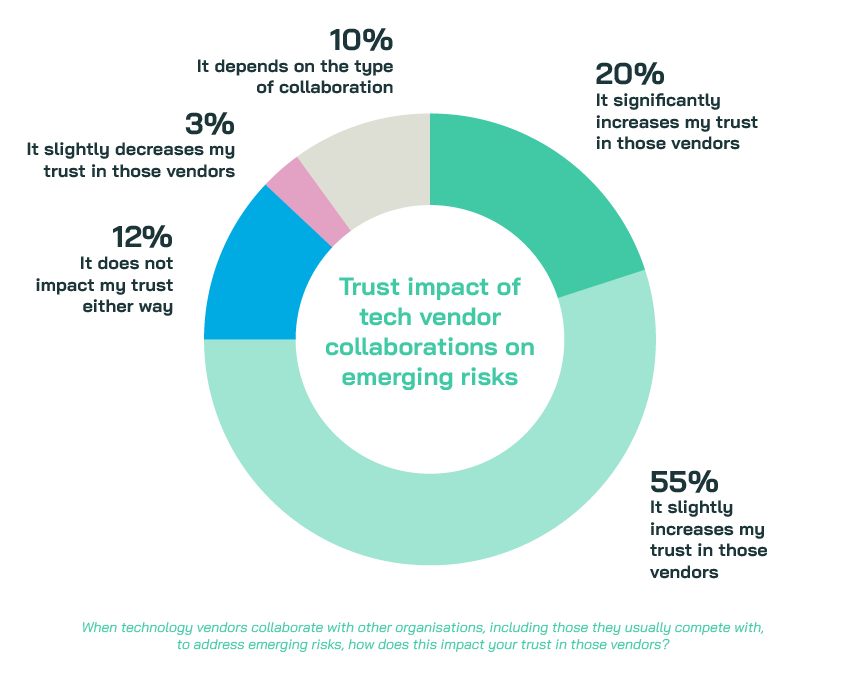
The findings also show that collaboration is not being seen as a weakness. Only a small minority (3%) say it slightly damages trust, and none say it significantly decreases trust. However, there is one important signal to consider. Over half (55%) say it only slightly increases trust, compared with 20% who say it significantly increases trust. This suggests collaboration can open the door, but it does not seal the deal. Vendors still need evidence to turn that initial trust into credibility.
This mirrors findings from our recent How brands know report among cybersecurity buyers, where 94% agreed that clear messaging and credible proof matter as much as product capability when gaining internal buy-in. Trust may create an opportunity, but proof is what helps buyers move forward with confidence.
Decision makers trust the idea more than the announcement
This is where the gap between action and communication starts to show. While collaboration itself increases trust, vendor announcements about AI security, AI safety and responsible AI are often viewed through a more sceptical lens.
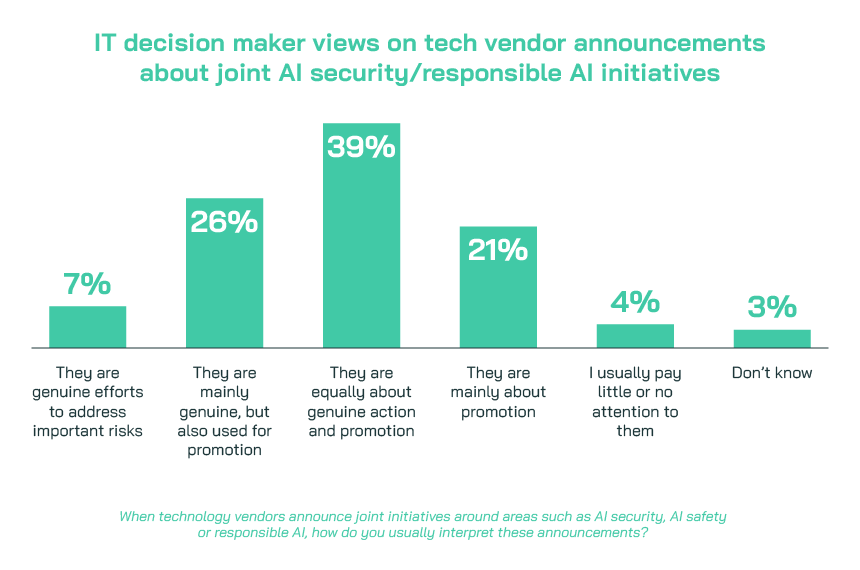
Around four in ten (39%) decision makers say these collaborative efforts are equally about genuine action and promotion, while 26% see them as mainly about promotion. If we look at these together, this means that over six in ten (65%) see these announcements as equally or mainly promotional. By contrast, only 7% see these announcements as genuine efforts to address important risks, while a further 26% see them as mainly genuine but also used for promotion.
That creates a critical tension in that decision makers might value collaboration, but they do not automatically trust how vendors talk about it.
The credibility gap sits in the messaging
IT decision makers are questioning announcements that rely on marketing language, limited detail or bold claims without credible proof. Many are concerned that vendors are using these topics to gain attention, rather than to show meaningful progress. Decision makers are looking for substance that helps them separate real action from promotion, particularly in a market that is overburdened with AI claims.
The thoughts of two IT leaders:
“Harder to read through the marketing buzzwords to the actual announcement that matters.”
“It would make me sceptical if the announcement was just full of marketing terms or buzzwords i.e. saying a lot without saying anything of any actual substance.”
The PR problem: collaboration can be weakened by the way it is communicated
The strongest theme in the scepticism from decision makers was frustration with hype, buzzwords, vague claims, lack of technical detail and announcements that feel designed to raise a vendor’s profile rather than solve a problem.
“Most vendors sing a song that is the right thing to say. Their focus is always on sales and nothing else.”
This is a critical point for technology marketers and comms teams. A collaboration may be meaningful internally, but if it is communicated with more of a promotional angle then decision makers may group it with every other AI announcement they see or hear. Essentially, it would not cut through the noise.
They also raised concerns around commercial motives. Some questioned whether vendors are using AI security and responsible AI to drive sales, attract investment, improve market position or create ‘fear’ around security concerns.
“I would be sceptical that vendors are simply making announcements to ‘scare’ companies and clients into spending more on security.”
“The likelihood that any announcement is driven by a profit motive rather than a desire to protect customers.”
This does not mean decision makers expect vendors to avoid commercial messaging altogether. It means they are looking for signs that collaboration is genuinely linked to customer risk, rather than purely for market positioning.
Proof beats partnership logos
What would make this collaboration feel meaningful rather than promotional?
The consensus from IT decision makers is clear and simple. They want proof.
For IT decision makers to feel confident in a vendor’s collaboration on emerging technology risks, they want independent validation, real-world use cases, measurable outcomes, technical detail and transparency.
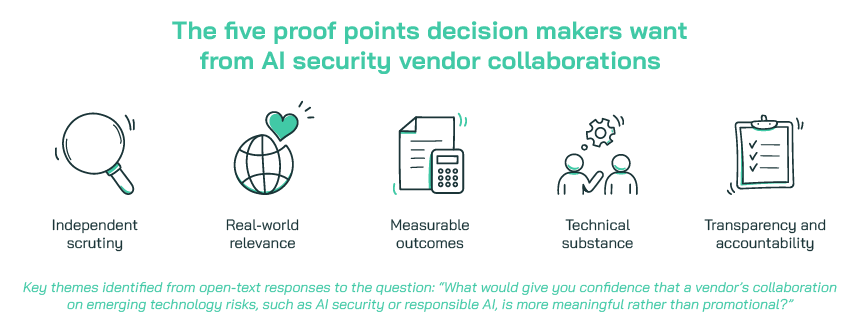
Decision makers want to understand what the collaboration has changed in practice – a case of walking the talk, rather than just talking the talk. They want to know how it has been tested, who has reviewed it, what standards have been used and how it reduces risk in practice.
“They can demonstrate data points that point to a reduction in risk to the organisation, not just marketing guff.”
“An independent review of all claims by a consistent third party would help.”
This is where the opportunity lies in how these collaborations are communicated to the relevant audiences. The collaboration itself is not enough. Decision makers need to see the substance and proof behind it.
This means vendors should not lead only with the names involved. They need to explain:
- What risks the collaboration is trying to address
- What has been tested, improved or learned as a result
- Which standards, frameworks or safeguards are being applied
- Who has independently validated the work
- How the collaboration helps customers make safer or better decisions
In summary: the announcement should be the start of the evidence trail.
Collaboration matters most when decision makers are comparing vendors
One of the key questions we asked was: where in the buying journey does this information carry the most weight?
Any information or messaging about vendor partnerships and collaborative initiatives is most likely to influence decision makers when they are actively comparing and validating vendors, rather than when they are simply becoming aware of the market.
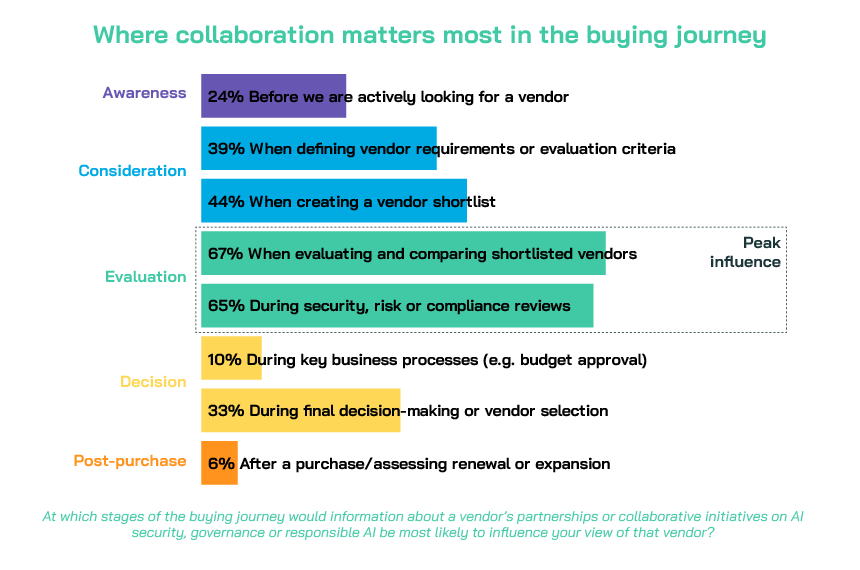
Two thirds (67%) say information about partnerships and collaborative initiatives would influence their view when evaluating and comparing shortlisted vendors, while a similar proportion (65%) say it would matter during security, risk or compliance reviews. It also has a role earlier in the process, with 44% selecting shortlist creation and 39% selecting the point where vendor requirements or evaluation criteria are being defined. By final decision-making or vendor selection, this falls to 33%.
This is the key point for marketers and comms teams. Collaboration should not be treated as a broad awareness message that sits at the top of the funnel and then disappears. Decision makers are most likely to value it when they are already weighing up their options, testing claims and deciding which vendors feel credible enough to move forward with (i.e. consideration and usage).
This should change how vendors package collaboration. It cannot just act as a press release or awareness campaign. If decision makers are using this information to compare vendors, then it needs to help them do that job.
That means turning collaboration into practical proof points that decision makers can use during evaluation. Examples could include:
- Security and risk review materials
- Governance explainers
- Technical validation documents
- Evidence packs for internal champions
- Case studies showing what changed as a result of the collaboration
- Independent third-party assurance
The real test is whether this information helps decision makers compare one vendor with another. If it does not, the collaboration may spark interest, but it will struggle to build confidence.
Trust is not the same as differentiation
This is where collaboration needs to be seen as part of a wider credibility story. To stand out on AI security, governance or responsible AI, vendors need more than involvement in an initiative. Decision makers are looking for proof, track record, independent scrutiny, clear governance, transparency, relevant case studies and open communication. This is how collaboration can support differentiation, as part of a wider credibility story.
“Proof of use in similar environments to us with proven results.”
“Would want to see rigorous and verifiable actions such as ISO audits, standards accreditation and certifications.”
This links clearly to brand. In a market where many vendors are saying similar things about AI security, governance and responsible AI, credibility can only be built over time. Decision makers are looking at what a vendor has already proved, how openly it communicates, whether others can validate its claims and whether its approach feels relevant to their own risks.
One decision maker sums it up simply:
“Open and honest communication.”
That may be one of the clearest messages from the research. In a fast-changing and noisy market, overconfidence can weaken credibility. Decision makers are more likely to trust vendors that are clear about what they have achieved, where the limitations sit and what still needs to be improved.
What this means for technology brands
The message for B2B technology marketers and PR/comms teams is clear: collaboration has value, but it cannot be treated as the proof point on its own.
Our research shows that collaboration on AI security and responsible AI can increase trust, support consideration and help decision makers compare vendors. Yet they are looking for evidence that the collaboration has substance, that it addresses real customer risks and that it leads to something they can clearly understand, test or verify.
That is the difference between collaboration as a brand message and collaboration as a buying signal.
The risk is that AI security and responsible AI become another layer of market noise, filled with similar-sounding claims and partnership announcements. The opportunity is to do something more useful. Vendors need to make collaboration specific, provable and relevant to the moments when buyers are deciding who to trust.
The brands that stand out will not be the ones making the biggest claims, but the ones backing them up with proof.
Signals for tech marketers:
1. Collaboration is a trust signal, but not a shortcut to trust
Most IT decision makers say collaboration on emerging risks increases their trust. But this is usually not a significant increase, meaning that collaboration opens the door rather than closing the credibility gap by itself.
2. Decision makers are aware of PR claims
Many see AI security and responsible AI announcements as at least partly promotional. If the message sounds too broad, too polished or too sales-led, decision makers may ignore it.
3. Proof matters more than partnership logos
The names involved in a collaboration are important, but decision makers also want independent validation, real-world examples, technical detail, measurable outcomes and transparency.
4. Collaboration has most value during active evaluation
This information is most influential when decision makers are creating shortlists, comparing vendors and going through security, risk or compliance review. It should be built into evaluation-stage materials and not just awareness campaigns.
5. AI credibility is built over time
Vendors stand out through proven results, track record, honesty, governance and relevant customer evidence. Collaboration can support this, but only when it fits into a wider credibility story.
Signals is our regular snapshot of what IT leaders are prioritising right now. Each month, we survey 100 UK IT decision makers across sectors, from organisations with 100+ employees. All are members of our expert network, the Vanson Bourne Community, giving you direct insight from the humans at the heart of tech.
Read more articles from our series below:
February: What’s shaping tech purchasing decisions in 2026?
March: The cost of inertia: Why “doing nothing” is your biggest competitor in 2026
April: In a world of automated touchpoints, do human interactions matter more than ever?
If you’d like to explore how these shifts are playing out in your sector, or go deeper into the data behind this edition, we’re always happy to continue the conversation.