






The B2B tech market is in constant flux. For marketers, understanding what your audience is thinking and doing is critical to cutting through the noise.
Each month, we explore the issues shaping real-world technology decisions, drawing on insight from 100 IT leaders in our expert network, the Vanson Bourne Community.
Welcome to the April edition of Signals.
This month, we set out to understand:
• How AI generated content is changing IT decision maker behaviour and perspectives
• How in-person events are shaping decision-making in 2026
• What IT decision makers value in events – and what they want to see more of
In March we looked into how IT decision makers win internal approval and found that vendors need to do more to help with the decision-making process.
This month, we wanted to understand the impact of AI-generated content and whether events and conferences are still popular sources given the boom in AI-material.
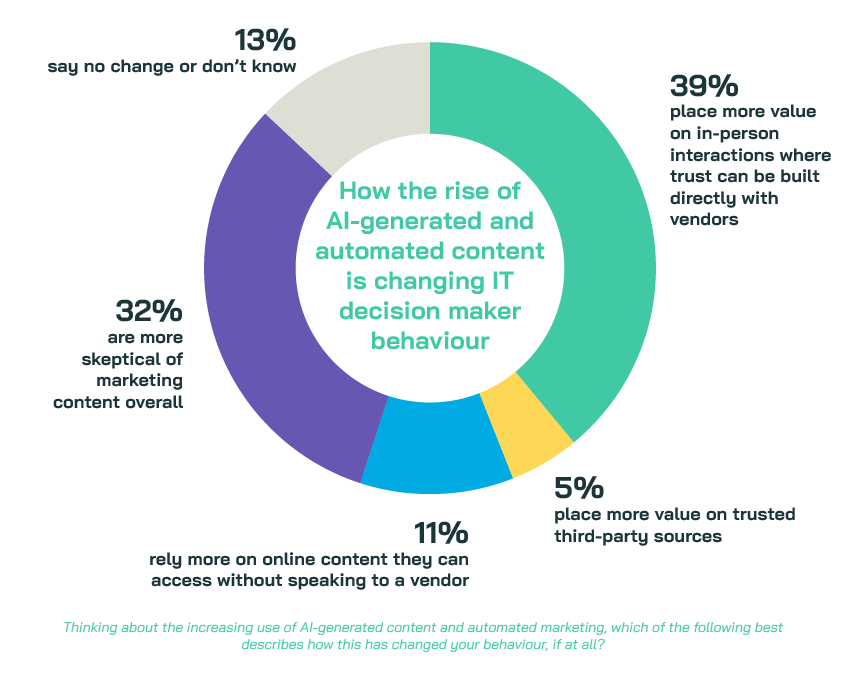
We spoke to 100 IT and technology decision makers in the UK about this and what we’ve found is that as buying journeys become more automated, trust is becoming harder to earn. In an upcoming report we found that AI is being used more to build awareness or understanding of a brand (going live soon!). This month in our Signals research, we found that with the increasing use of AI-generated content and automated marketing, one in three (32%) are more sceptical of marketing content.
Or as one IT leader put it:
“You cannot build trust with AI and you don’t get the same human emotions with AI”
This opened up even more questions for us.
With the AI revolution and teams relying on it increasingly for efficiency and productivity gains, what does that mean for decision makers, are they starting to feel everything sounds the same? And are events still something that decision makers find value in?
Here are the thoughts of one IT decision maker we surveyed:
“Significant amounts of marketing that I see have lots of AI blurb to go with them, these are generally online posts on the likes of LinkedIn, unfortunately it seems that a lot of these use AI poorly and do not do validations against what is being posted, so it means that I trust all marketing content less as it is more work for me to verify accuracy”
Embracing events?
At a time when marketing is becoming more automated, you might expect the purchasing journey to follow suit. Yet the reality is the opposite. The journey is becoming more complex with more stakeholders involved, growing procurement hurdles and reduced budgets.
As a result, buyers aren’t consolidating their engagement around one or two key channels. Instead, they are spreading their attention across a wide mix of touchpoints with direct vendor contact becoming more important.
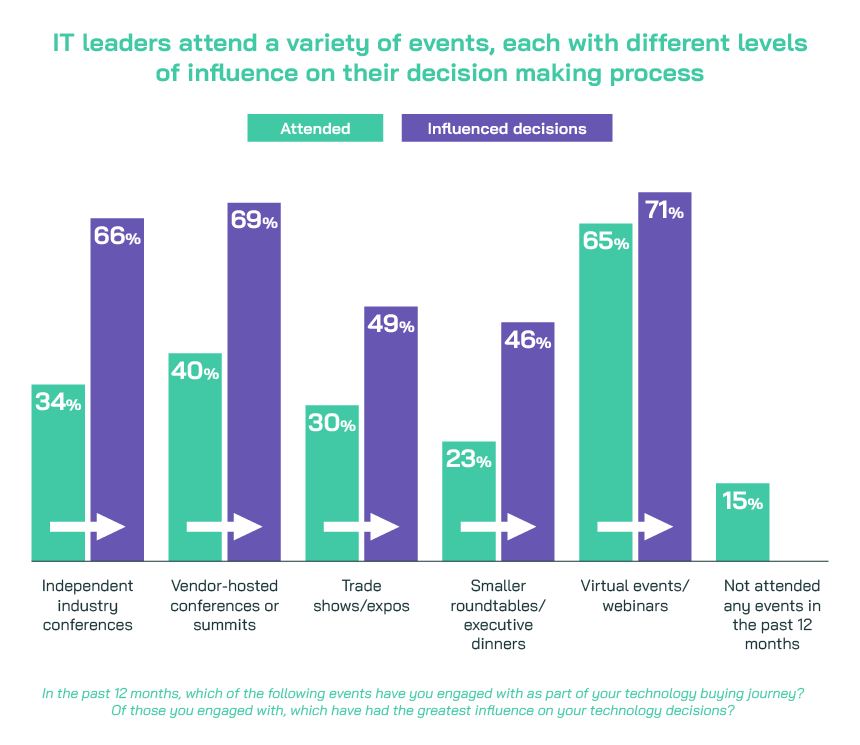
Within the last 12 months:
- 65% have attended virtual events or webinars
- 40% have attended vendor-hosted conferences or summits
- Only 15% say they haven’t attended any events at all
We also see that these events are influencing the decision-making process.
As a result of attending an event, over half (55%) have engaged in further discussions with the vendor and 48% have researched the vendor online, or shared vendors information with colleagues internally. 31% have also shortlisted a vendor from an event and 25% said they made a purchase decision.

This highlights clear reasons to host events for your brand. Decision makers attend an event and then act.
Outside of greater clarity of vendors and whether a decision maker is going to purchase their product, event attendees see value in events as it provides network and engagement opportunities as well as gaining ‘insider’ insight.
Here’s a sample of how events have helped IT decision makers:
“Attending events puts your company and products in the spotlight of the industry. You can also make new and existing partnerships from in depth discussions at these events”
“Attending events has helped me stay updated on emerging technologies, industry trends, and best practices in IT. It has also allowed me to network with professionals, exchange ideas, and gain insights that improve my problem-solving, system design, and strategic thinking skills.”
“Meeting different vendors and learning about new technologies is an eye opener. The added benefits are sharing ideas and knowing what technologies can be implemented in the future.”
In a world where content is easy to generate, decision makers are finding real-world, human interactions become more important and harder to replace.
“Real-world experiences are far more valuable than AI generated content. We have asked AI for solutions to issues and the results are rarely definitive, but speaking to someone who has faced similar issues often gets results.”
So, what could make events even more valuable?
Our decision maker respondents report that to get even more value out of events, they’d want:
- The event to be in a more convenient location
- To see content that is relevant to their role and specific business challenges
- To have content that is less sales-driven and more independent
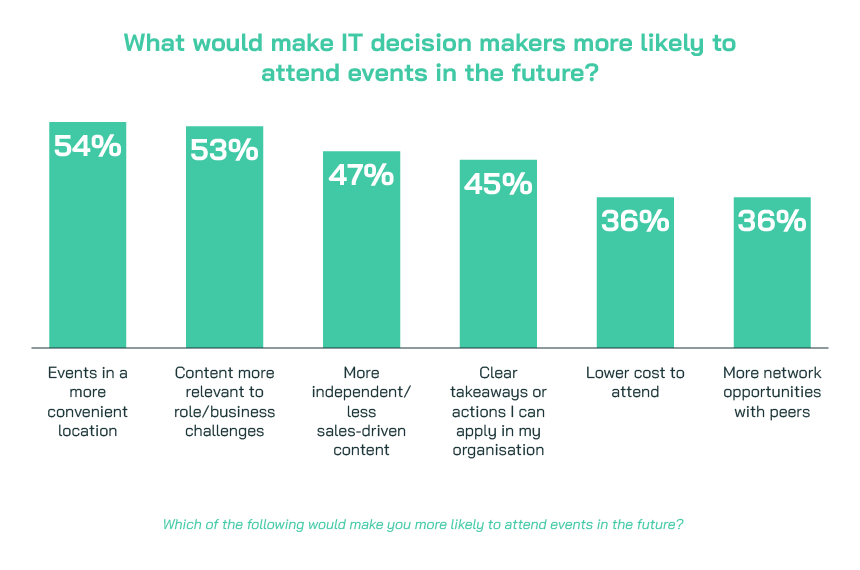
While events deliver value, attendance isn’t always guaranteed. Practical barriers such as cost, or location, play a role in if a decision maker can attend an event, but they’re not the main decider. It seems that if the content is relevant and credible, decision makers see the value in events.
This is likely even more the case now that AI is making it easier to access information. As content scales but scepticism grows, decision makers are looking for more than just information, they’re looking for connection and confidence.
And that’s where human interaction and events play a role. They provide a space to validate, challenge and build trust with peers and brands in real time. As AI continues to grow and influence our content, these human interactions will become more important.
Signals for tech marketers:
1. Human interaction is becoming a competitive advantage
As IT decision makers become more sceptical about AI-generated content, there’s a greater focus on environments where trust can be built directly with vendors and peers.
2. Events drive action
Events don’t just build your brand awareness. Many decision makers use events to decide whether they want to purchase your product or share your brand’s details with colleagues. Be careful not to make event content too sales heavy though as this can have the opposite effect.
3. The purchasing journey is growing in complexity
With growing complexities, demands and internal logistics the purchasing process is getting trickier. Decision makers are therefore leaning on more sources of information to connect with vendors, with events being key in gaining the human relationship.
4. Relevance is the difference between attendance and avoidance
Decision makers time and attention are limited. Events are a way they are able to connect with likeminded people as long as they’re based on independent findings and content, and not too heavily sales focused.
5. Produce content and events that provide buyer validation
The most valuable events to decision makers enable them to choose direction, not just grow awareness of a brand. They help buyers connect with the brand, understand how the product can work for them and ultimately gain confidence in their decision.
Signals is our regular snapshot of what IT leaders are prioritising right now. Each month, we survey 100 UK IT decision makers across sectors, from organisations with 100+ employees. All are members of our expert network, the Vanson Bourne Community, giving you direct insight from the humans at the heart of tech.
Read more articles from our series below:
February: What’s shaping tech purchasing decisions in 2026?
March: The cost of inertia: Why “doing nothing” is your biggest competitor in 2026
If you’d like to explore how these shifts are playing out in your sector, or go deeper into the data behind this edition, we’re always happy to continue the conversation.