






Brand research is rising up the agenda for B2B tech marketers. In a sector shaped by noise, shifting expectations and internal pressure, many are seeking to understand how their brands are truly perceived and what that means for confident decision-making.
It’s clear from the conversations we have with tech marketers that the expectations and demands placed upon them continue to rise. Driving growth, proving impact, differentiating in crowded spaces, often with tighter budgets and less resources than before.
Now, with the rapid growth of GenAI, we have a volume problem. Everyone’s feeds are full and reports are everywhere. Brands blur together. Thought leaders are starting to sound like followers.
AI tools can generate plausible-looking insight in seconds, meaning content is easier to produce than ever, but increasingly generic and harder to trust. And in a sector where most buyers aren’t actively in-market at any given time, being remembered matters more than simply being visible.
As one IT leader told us in our B2B Tech Ad Playbook last year: “I think the challenge with a lot of tech comms is they don’t really tell you anything”.
A major obstacle with all that information is that it does not automatically lead to clarity. And without clarity, confident decisions become harder to make.
Under all that pressure, decisions start to stack up. Which positioning do we commit to? Which messages do we double down on? Which narrative do we take to market this quarter? What do we stop doing?
Each of those choices carries risk, whether commercially, reputationally or even politically inside the business. But here’s a question for you: What are those decisions actually grounded in?

Thinking you know, isn’t the same as knowing you know
Any of this sound familiar?
- Lacking time, resources or direct access, you’re running on a kind of informed instinct
- You might be lucky enough to talk to customers, but more likely you’re getting second-hand feedback from sales
- In search of insight, you’re wading through campaign metrics across multiple tools and scrolling through industry commentary
- Increasingly you find yourself turning to AI to summarise what is happening and what it means
All helpful to a point. But it’s not the same as knowing, with real evidence, how your brand is actually perceived in the market.
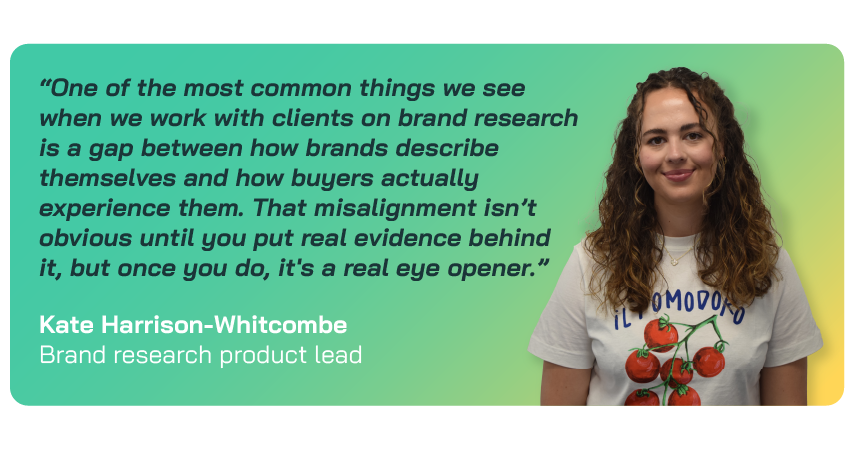
We recently worked with a global software brand that felt confident in its positioning… until the research revealed that buyers described them almost identically to two key competitors. The differentiation they believed they had simply wasn’t landing.
Without such insights, strategy can start to feel uncertain, messaging becomes a series of educated guesses and confidence begins to erode.
In markets that move fast, activity is easy and noise is constant. Clarity is much harder to come by. It’s what allows teams to move forward without second guessing themselves, backing up their decisions with evidence.
It’s at this point that many of the tech marketing teams we speak to realise instinct isn’t enough — and why we’re seeing more brands invest in getting an objective view of how they’re truly perceived.
Because you cannot decide where to go until you know where you are.
From guesswork to groundwork
The strongest marketing teams are not necessarily the busiest or the noisiest. They are the ones who understand, in detail, how their brand is seen by the people who matter most: customers. In an ever-changing market like B2B tech, specialist brand research gives you that platform. Not as a campaign add-on or a box-ticking exercise, but as a launchpad for decision making.
When you know how buyers describe your brand in their own words, several things start to change. You can commit to positioning with more conviction, prioritising messages that resonate and retiring the ones that do not. You can explain to senior stakeholders why a particular direction makes sense and make moves with more confidence because fewer decisions are based on guesswork.
For B2B tech marketers, that’s a powerful place to be. It means replacing past assumptions with current evidence and turning tiresome debates into productive discussions. In essence, having something solid to stand on.

Confidence as a competitive advantage?
We’re not talking about the loud, brash kind of confidence here, but more the kind that comes from understanding how your brand is perceived, where it is trusted, and where it blends in. Confidence built on direct insight from the people you are trying to reach.
This is how brands know…
…what buyers really think
…when to commit and when not to
…which messages to stand behind
…whether they’re trusted
So how confident are your brand decisions, really?
Coming soon: insights from IT leaders on tech brands
In brand-new research, we’re exploring what this means for B2B tech brands and how senior IT decision makers are reassessing the brands they engage with.
The findings will uncover:
- Which tech brands are standing out above the crowd – and why
- How tech buyer priorities and expectations are rapidly shifting
- Where trust and authority are being built and lost
- …and more
Look out for the full report coming soon.
In the meantime, if all this resonates with what you’re facing, let’s talk about how brand research can give your team the clarity and confidence you need to win.
Want to keep reading? Discover more insights direct from IT leaders:
What’s shaping tech purchasing decisions in 2026? Find out in the February edition of our brand new series, Signals
Top tips on how to create messaging that moves: The B2B Tech Ad Playbook.
Everyone says they’re customer-centric. But are they really? It’s easy to say, harder to do.