






The B2B tech market is in constant flux. For marketers, understanding what your audience is thinking and doing is critical to cutting through the noise.
Each month, we explore the issues shaping real-world technology decisions, drawing on insight from 100 IT leaders in our expert network, the Vanson Bourne Community.
Welcome to the March edition of Signals.
This month, we set out to understand:
• Who is playing a decisive role in technology purchasing in 2026
• What IT have to prove to get investment signed off – and where things fall down
• How vendors can better support with internal approval processes
In February’s edition of Signals, we saw a market turning defensive. Budgets were tightening with non-essential spend being cut. AI seems to be protected, but everything else is under pressure.
This month, we decided to explore what that environment is actually doing to decision-making. The picture that comes through is a process defined by scrutiny, complexity, and increasingly, attrition. ROI has always mattered, but there seems to be less tolerance for benefits that are harder to quantify. Customer experience, transformation and competitive advantage are being de-prioritised in favour of immediate, measurable financial impact.
Stakeholders, scrutiny and sign off
On paper, technology decisions in 2026 look collaborative. Long gone are the days when IT decides what they spend their money on: while they still play a central role, they no longer act alone. Instead, IT security, leadership and finance are all deeply involved in shaping outcomes.
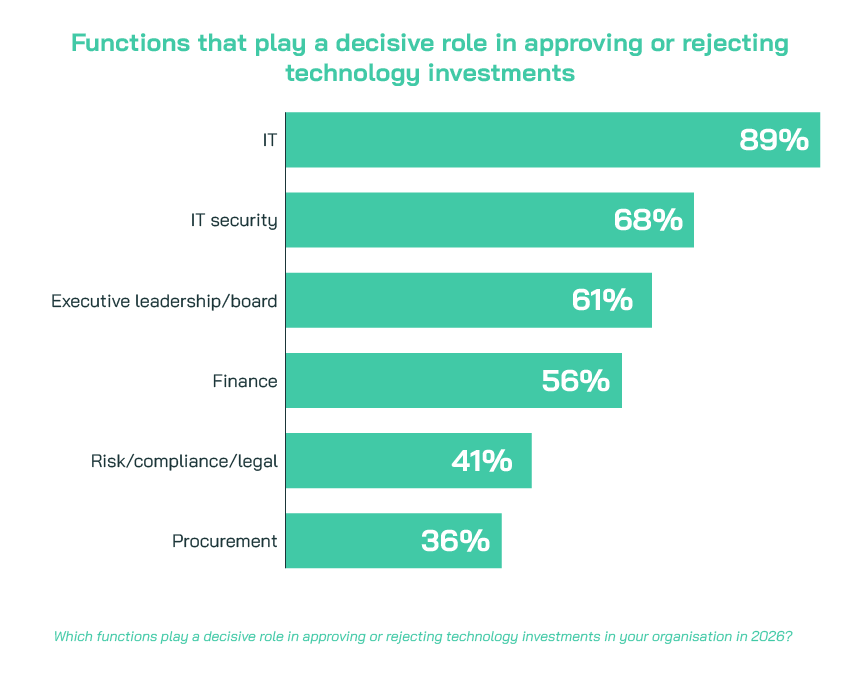
For IT leaders, this means building a case that can hold up across multiple audiences in the business. For tech vendors, this shared influence reframes the challenge they face. You’re not just convincing one buyer or even one department to buy from you. Instead, you need to help your internal champion navigate competing priorities and scrutiny across multiple areas, from technical validation, through to financial justification and strategic alignment.
And while influence is distributed, where decisions actually fall down lies primarily with one function: finance.
Nearly half (48%) of IT decision makers say that investments are most likely to stall or face pushback during finance review and ROI assessment, far higher than any other stage in the approvals process.
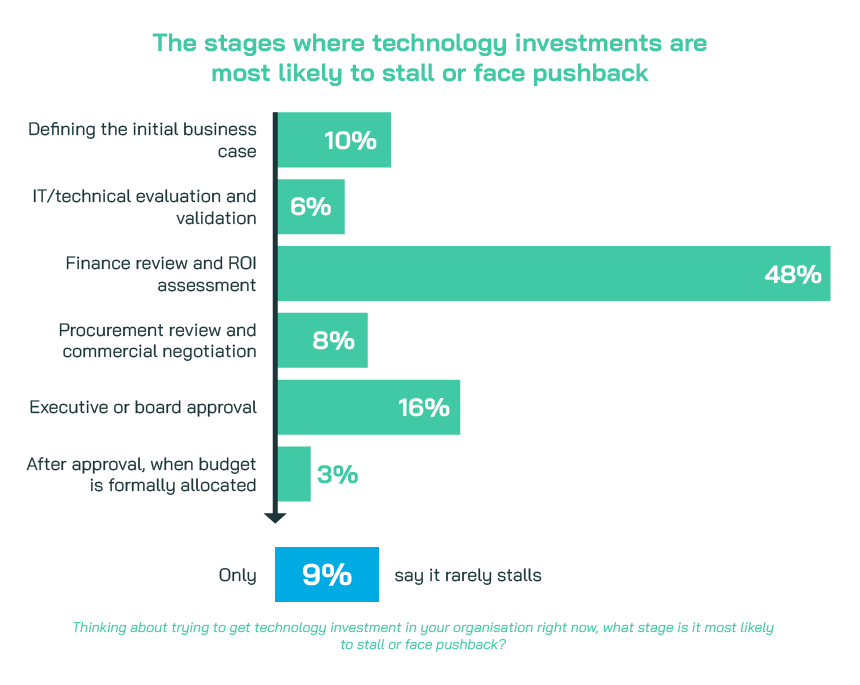
This reflects the kind of scrutiny IT leaders now face. ROI was the most common evidence they are asked to provide when seeking investment approval, with 41% of our respondents referencing it in their verbatim responses.
“ROI of the project would be a driving factor”
“ROI is by far the biggest point at the moment – will it save us money in the short to medium-term, and can we afford the initial outlay?”
“What is the ROI over three years if we deploy this technology?”
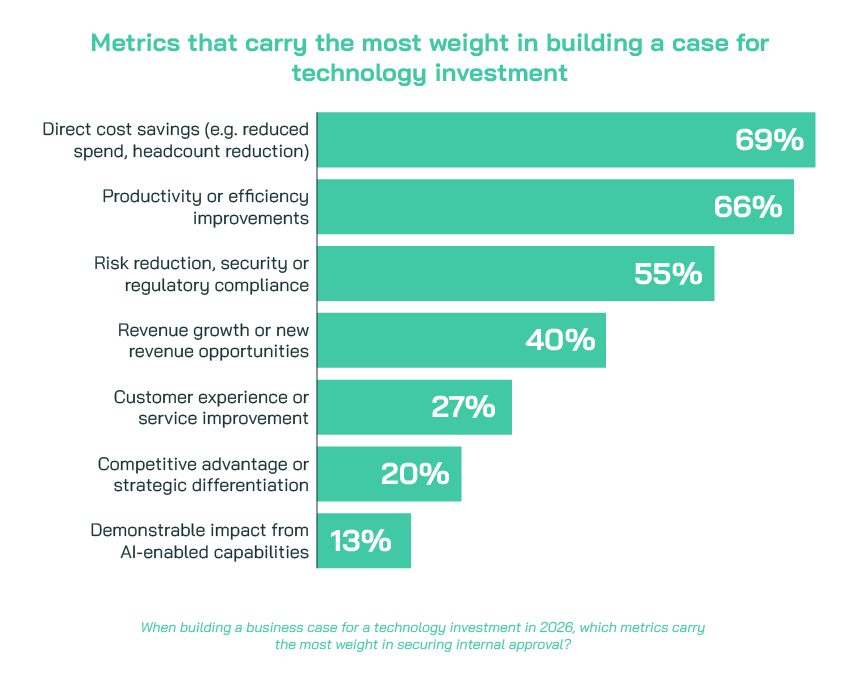
And being able to provide metrics around direct costs savings (69%) and productivity and efficiency gains (66%) were the most likely to carry weight in a business case for our respondents too. In fact, bottom of that list were more strategic outcomes and growth indicators:
- Customer experience improvements (27%)
- Competitive advantage and differentiation (20%)
- Demonstrable impact from AI-enabled capabilities (13%)
The bar for approval is high and it requires proof, not vision and concepts. Businesses seem far more interested in financial impact right now, than they are in growth or differentiation of the future.
The internal case for “doing nothing”
There are plenty of ideas and business cases which never even enter the approvals process at all. Over half (51%) of IT leaders say they have delayed, paused or cancelled a technology investment in the past 12 months because securing internal approval felt too difficult or time-consuming, and one in four (26%) say this has happened on multiple occasions. In some cases, that hesitation starts even earlier with one in ten (9%) reporting that they haven’t attempted to pursue a technology investment in the past year.
When building a business case means navigating multiple stakeholders, defending assumptions and standing up to detailed financial scrutiny, the path of least resistance becomes increasingly attractive. Delaying, or not progressing the idea at all, becomes a rational choice.
In 2026, the biggest competitor to any technology vendor is not always another supplier. It’s the internal case for doing nothing.
So if this is the reality of how decisions are now made, it raises the practical question: what can vendors do differently to help progress decisions in a way that is beneficial to them and their customers?
Signals for tech marketers
Building on previous findings we uncovered in our B2B Tech Ad Playbook in 2025, we asked respondents what tech vendors could do to help them navigate their approvals process with ease.
1. Make the business case concrete
“We need genuine solid facts, not marketing fluff”
Too often, the business case is vague. IT leaders repeatedly point to overpromised outcomes and a lack of tangible evidence into how the ROI will actually be realised. In an environment where financial justification is the driving factor behind approving a tech investment, it’s crucial for this to be clear and specific.
2. Show you understand the organisation, not your product
“Rarely do they embed themselves in the organisation to try and understand”
IT leaders felt there is a clear gap between how well vendors grasp the environments they are selling into. Many describe suppliers overlooking internal complexity, sector-specific constraints and regulatory requirements. While no vendor can fully understand every organisation upfront, those who take the time to tailor as much as possible, rather than relying on a standard pitch, are more likely to be taken seriously.
3. Support your internal champion during the approval process
“Often vendors believe that one person is the decision maker and let them champion it. In reality… it has to pass through several departments and several heads.”
There is a tendency to focus on selling the solution in, rather than helping to get it approved. Many IT leaders feel that they are left to navigate the hardest part alone, leading to delay and de-prioritisation. In reality, there are small things that can make a big difference in this stage. Practical support and materials like pricing models, implementation timelines and the final documentation for sign off are all meaningful ways for vendors to support the process and subsequently encourage decisions to progress in their favour.
Signals is our regular snapshot of what IT leaders are prioritising right now. Each month, we survey 100 UK IT decision makers across sectors, from organisations with 100+ employees. All are members of our expert network, the Vanson Bourne Community, giving you direct insight from the humans at the heart of tech.
If you’d like to explore how these shifts are playing out in your sector, or go deeper into the data behind this edition, we’re always happy to continue the conversation.