






“I’m going to Graceland, Graceland in Memphis Tennessee …”.
Until recently, Graceland and Paul Simon singing about it were pretty much all I knew about Memphis, Tennessee. That and the Peabody Ducks. But then came Colossus, xAI’s supercomputing cluster, the infrastructure backbone for Grok. Brought online in just 120 days it uses such a colossal amount of electricity that gas-powered generators have been deployed (illegally, it seems1) to keep the facility running. Fossil fuel burning, emissions generating gas-powered generators.
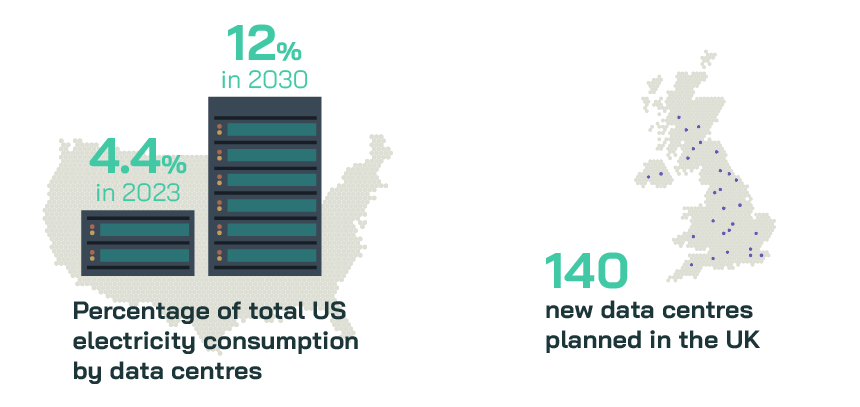
It’s not just Colossus, of course. Hyperscale data centres packed with advanced chips and sophisticated cooling are springing up all over the world and they need a lot of electricity. In the US, the Lawrence Berkeley National Laboratory estimates that data centres consumed 4.4% of the nation’s total electricity in 2023 and some reports project that this figure will increase to around 12% by 20302. On this side of the pond, 140 new data centres are planned and Ofgem forecasts that the associated demand for electricity will significantly exceed the UK’s recent peak electricity consumption, posing challenges to grid capacity3.
This surge in AI-driven data centre development is complicating efforts to achieve clean power and emissions targets. 3 or 4 years ago, it was hard to find a corporate strategy deck that didn’t have environmental commitments at its heart. ESG, sustainability, net zero … they were all the rage. In November 2022, for example, research of UK IT and business decision makers4 found that 61% of organisations reported having environmental sustainability policies in place. More than had anti-bribery policies or modern slavery policies.
Do organisations recognise the challenge and how do they reconcile their sustainability ambitions with the competitive pressures to adopt AI solutions at speed? Our February 2026 survey of UK IT decision makers5 has found that most organisations perceive that they are having to choose between meeting environmental sustainability commitments and achieving their AI ambitions.
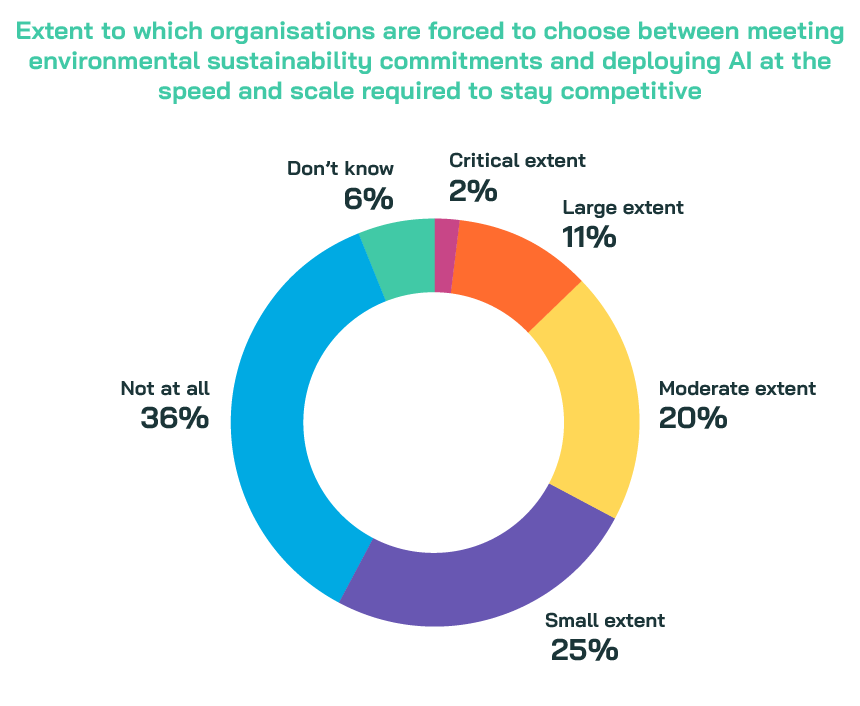
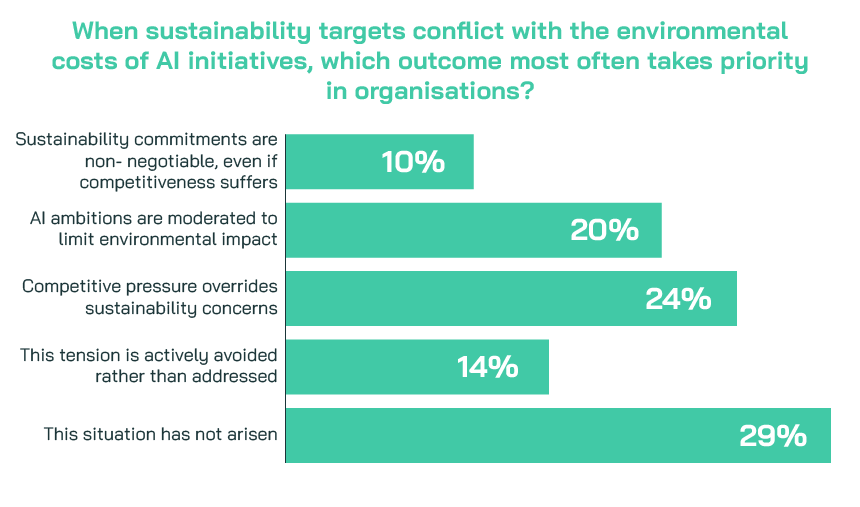
More often than not, competitiveness prevails over sustainability targets. One in four (24%) respondents reported that the pressure to pursue AI initiatives overrides any sustainability concerns, if the two come into conflict. Just 10% stated that their organisation’s sustainability commitments are non-negotiable.
There are clear examples of how the competitiveness argument is winning out over the sustainability one, both at a corporate and at a national level. A year ago Microsoft, long positioned as a sustainability front-runner with its “carbon-negative by 2030” pledge, acknowledged that AI-driven data centre expansion has materially increased its emissions footprint. In the UK, data centres have been designated as Critical National Infrastructure, with the Energy Secretary stating that the “climate impact of data centres is uncertain”6. It is true that many data centres in the UK use renewable energy and conserve the water used for cooling, but as we’ve seen in Memphis there is pressure to compromise in the drive to build data centres at speed.
At some point pressures from regulatory authorities, special interest groups or customers might cause the pendulum to swing back towards environmental concerns and sustainability. US lawmakers in a number of states have proposed legislation to pause or restrict new data centre developments whilst a coalition of 230 environmental groups recently demanded a moratorium on new data centre construction.
Undoubtedly, organisations will welcome efforts by technology vendors to help them square this circle. Efficiency improvements, transparent carbon reporting, investments in renewable infrastructure, lower-carbon architectures, closed-system cooling, smarter workload placements … there are any number of ways in which vendors might support their clients to achieve their sustainability goals AND their AI ambitions. For marketing leaders, that means grounding positioning in robust data and clear proof points. In the highly competitive B2B technology market, those able to substantiate their impact with credible insight will find themselves at a distinct advantage.
References:
2 Congress.gov Data Centers and Their Energy Consumption, 23 January 2026
3 Ofgem.gov.uk Demand Connections reform, 13 February 2026
4 Vanson Bourne Survey of 100 Business and IT decision makers, November 2022
5 Vanson Bourne Signals Survey of 100 IT decision makers, February 2026
6 BBC.co.uk Ed Miliband says climate impact of data centres is uncertain, 26 February 2026